A jetboard is a surfboard with its own power — you need no wave, no wind, just enough water underneath you. At E-SURFER we have ridden every model we sell since 2017. Here is which board suits you, when an electric drive is the right call, and when it isn't.
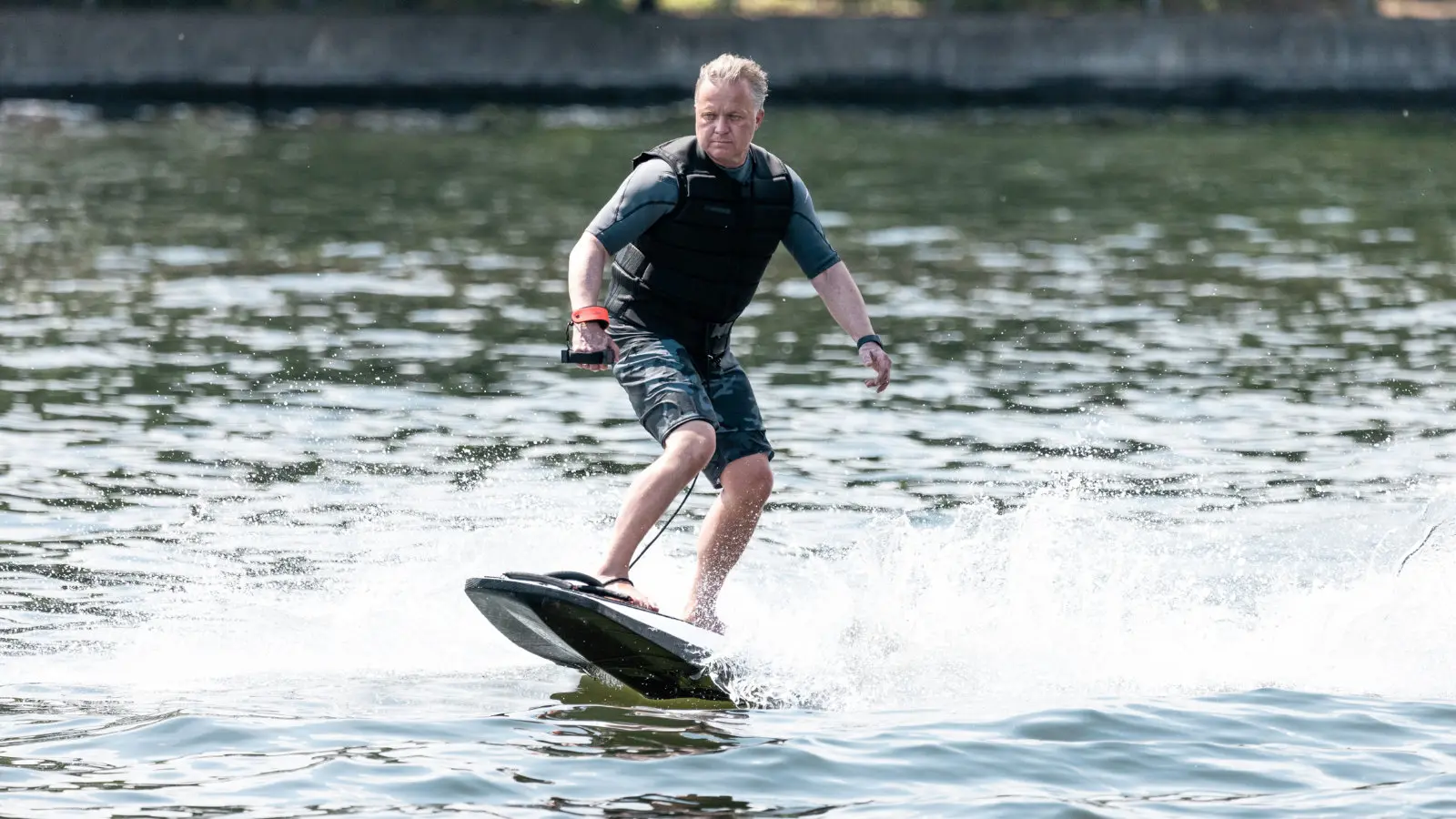
A high-quality jetboard costs between €12,000 and €20,000 in 2026. With us, boards start at €12,388 for the Awake RÄVIK Explore. We are often asked for a powerful electric surfboard under €5,000. It does not exist.
A jetboard is not a surfboard with a motor added, but a watercraft in its own right. So don't calculate “€2,000 for the board plus €2,000 for motor and electronics”. The fair comparison is a jet ski, and that also costs between €10,000 and €25,000.
The biggest cost item is the battery. It accounts for roughly 30 to 40 percent of the price, and speed and range depend on it. Cheap cells and a weak battery management system (BMS) save a few thousand euros, but raise the risk of damage and fire. That is why most jetboards under €10,000 are really built for light riders under 70 kilograms.
When you compare prices, look closely at what is included. Many manufacturers list prices on their websites without VAT, shipping and import costs. That can easily add a few thousand euros. Our prices include VAT – more on that below under shipping and VAT.
That depends less on how well you ride than on who else will be using the board. Our customers fall into two groups: families who want one tough machine that everyone can handle, and sporty riders chasing a very particular feel on the water. There is a clear answer for both.
If several people of different weights share the board, the size depends on the heaviest rider. If the board is too small for them, it sits too low in the water, won't get up onto the plane, and the motor can overheat. A bigger board isn't boring for lighter riders – just less sporty.
For almost everyone: electric. We stock both drive types, which means we have no reason to talk one of them up — most retailers sell only one kind and argue accordingly.
Electric is the right choice for everything that happens at home, at the holiday house or off a boat. No petrol on board, no fuel mixing, no oil change. You ride in near silence, which on many lakes is the difference between allowed and not allowed. And in spring there is no engine in the garage that has to be coaxed back to life — you charge the battery and go.
Petrol has three arguments. Two of them count almost only in racing: the board is lighter because there is no battery pack in the hull, and you refuel in two minutes while a jetboard battery needs two to three hours. On the mo-jet it is roughly half that — it carries two batteries and two chargers that run in parallel, so you are back on the water after a good hour. If you ride ten heats on a race day, you need that head start. If you are out on a Saturday, you don't.
The third argument affects far more people than racers: you can take a petrol board on a plane, an electric one you cannot. With a combustion board you have to drain the tank completely, then transport is possible. A drive battery of that size is not allowed on a passenger aircraft — not even in checked luggage. If your board is meant to travel with you regularly, this is the point where the decision tips.
Our honest recommendation: buy a combustion board if you intend to race, or if your board has to fly often. In every other case you will be glad of the electric drive every single time you put the board in the water.
If you want sharp turns and fast manoeuvres, go for a short board with foot straps. It is harder to ride but much more agile. Not necessarily faster, though, because a small board sits deeper in the water and needs more energy. If you prefer it relaxed, choose a bigger board with more volume.
Some jetboards have a leash at the nose with a handle to hold on to. It makes riding easier and helps with steering, which is why some very sporty boards have one too. On some boards it can be removed. We prefer riding without it – for the freedom on the board.
We carry three brands, and only ones we have ridden ourselves and keep spare parts for. Each of them is built for a different rider.
mo-jet is our best-selling jetboard brand, for two reasons: toughness and modularity. The hull is made of the same plastic as a kayak. Scrapes on the slipway, coming alongside a jetty, sand and gravel on the beach — it takes practically none of it to heart. The same drive module powers the bodyboard, the jetboard and the tender, so you are not buying one craft but a system you can extend. For families, and anywhere several people share the board, it is the most sensible solution on the market.
The mo-jet BODY is available from €14,759, the SURF module for an extra €839. As a pure jetboard, the mo-jet SURF is available from €14,995.
Awake Boards from Sweden builds the most refined board in our range. The RÄVIK is a full carbon craft with a level of finish you feel the moment you pick it up — a design piece that also rides like one. The two models are now called RÄVIK Ultimate and RÄVIK Adventure.
The RÄVIK Ultimate is available from €19,499, the RÄVIK Adventure from €17,990. The range also includes the Awake RÄVIK Explore from €12,388.
JETSURF comes out of motorsport and makes no secret of it: the boards are narrow, light and built for competition. They exist as electric and as combustion models — if you want to enter race classes, this is the brand to look at.
The JETSURF Electric 2 is available from €14,869, the electric jet ski from JETSURF from €16,648. The combustion models start at €13,078.
Six things that shape daily life with the board and rarely show up on a spec sheet:
A jetboard needs a leash with a magnetic kill switch. You attach it to your ankle or your vest. The kill switch has two jobs: as long as the magnet is not in place, the motor can't start by accident. And if you fall, the leash pulls the magnet off and the motor stops immediately.
Unlike on an eFoil, the leash is essential on a jetboard, because a jetboard can keep going without its rider. Always wear a helmet and a vest as well.
Hardly a quarter goes by without a new jetboard being announced somewhere. Many of them never reach the market. It usually takes two years to get from a working prototype to a mature series product. So we are careful with newcomers that advertise attractive prices.
Cheap models from Asia undercut the established brands by up to 60 percent. That sounds tempting. What matters, though, is who helps you after you buy: you need a contact near you, spare parts, and the chance to ride the board before you buy. Otherwise disappointment comes quickly. In the E-SURFER shop we only sell boards we have ridden ourselves and keep spare parts for.
Because of its battery, an electric jetboard is shipped as dangerous goods.
The E-SURFER team holds all transport certifications for air freight, sea freight and road, and prepares the documents for its customers itself.
All prices in our shop include 19 percent German VAT, because we are a German retailer. For deliveries to other EU countries, the VAT rate of the destination country applies – the price is adjusted accordingly when you order. Businesses with a valid VAT ID can be supplied within the EU without VAT. Watch how other sellers handle this – some only show the tax at checkout, and the product suddenly costs around a fifth more. When importing directly from overseas, customs duties and handling fees come on top, and you often only find out about them once the shipment is held at customs.
In Berlin. Jetboard test rides take place at our Berlin location only — there you ride the boards yourself before you decide, with an introduction from trainers who have been in the sport for years.
Our most honest advice after eight years in this sport: nobody buys a jetboard from a spec sheet. Stand on a mo-jet once and on a RÄVIK once, and within half an hour you will know which one is yours.
A high-quality jetboard costs between €12,000 and €20,000 in 2026, including 19% VAT. At E-SURFER, prices start at €12,388 for the Awake RÄVIK Explore. The mo-jet BODY starts at €14,759, the JETSURF Electric 2 at €14,869 and the Awake RÄVIK Ultimate at €19,499. Powerful electric jetboards under €5,000 do not exist.
The best jetboard depends on who rides it. For families, holiday homes and yachts we recommend the mo-jet BODY with the SURF module, the most robust board we sell. Sporty riders who care about design choose the Awake RÄVIK Ultimate or RÄVIK Adventure. From the racing scene comes the JETSURF Electric 2. The safest way to decide is a test ride with us in Berlin.
In the UK, there is no national licence or registration for recreational craft, but local byelaws and harbour authorities set the rules. On canals and rivers run by the Canal & River Trust, on the Thames and on Scottish canals you need a licence or registration. In the US, it depends on the state: jetboards must be registered as vessels, and many states treat them as personal watercraft, with a minimum age, life jacket rules, no riding after dark and often a boating safety course. Ask us before you buy.
Electric jetboards need little maintenance: no fuel, no oil changes. Rinse the board with fresh water after every saltwater session and keep the jet intake free of sand and seaweed. The biggest cost is the battery: a spare battery set costs €3,549 for the mo-jet and €7,369 for the Awake RÄVIK. We keep spare parts in stock for every jetboard brand we sell.




PayPal uses Google reCAPTCHA to help secure the payment process. (More Information)
You need to load content from reCAPTCHA to submit the form. Please note that doing so will share data with third-party providers.
More InformationYou are currently viewing a placeholder content from Turnstile. To access the actual content, click the button below. Please note that doing so will share data with third-party providers.
More InformationYou are currently viewing a placeholder content from Facebook. To access the actual content, click the button below. Please note that doing so will share data with third-party providers.
More InformationYou are currently viewing a placeholder content from Instagram. To access the actual content, click the button below. Please note that doing so will share data with third-party providers.
More InformationYou are currently viewing a placeholder content from X. To access the actual content, click the button below. Please note that doing so will share data with third-party providers.
More Information


 GO TO PRODUCTS


